
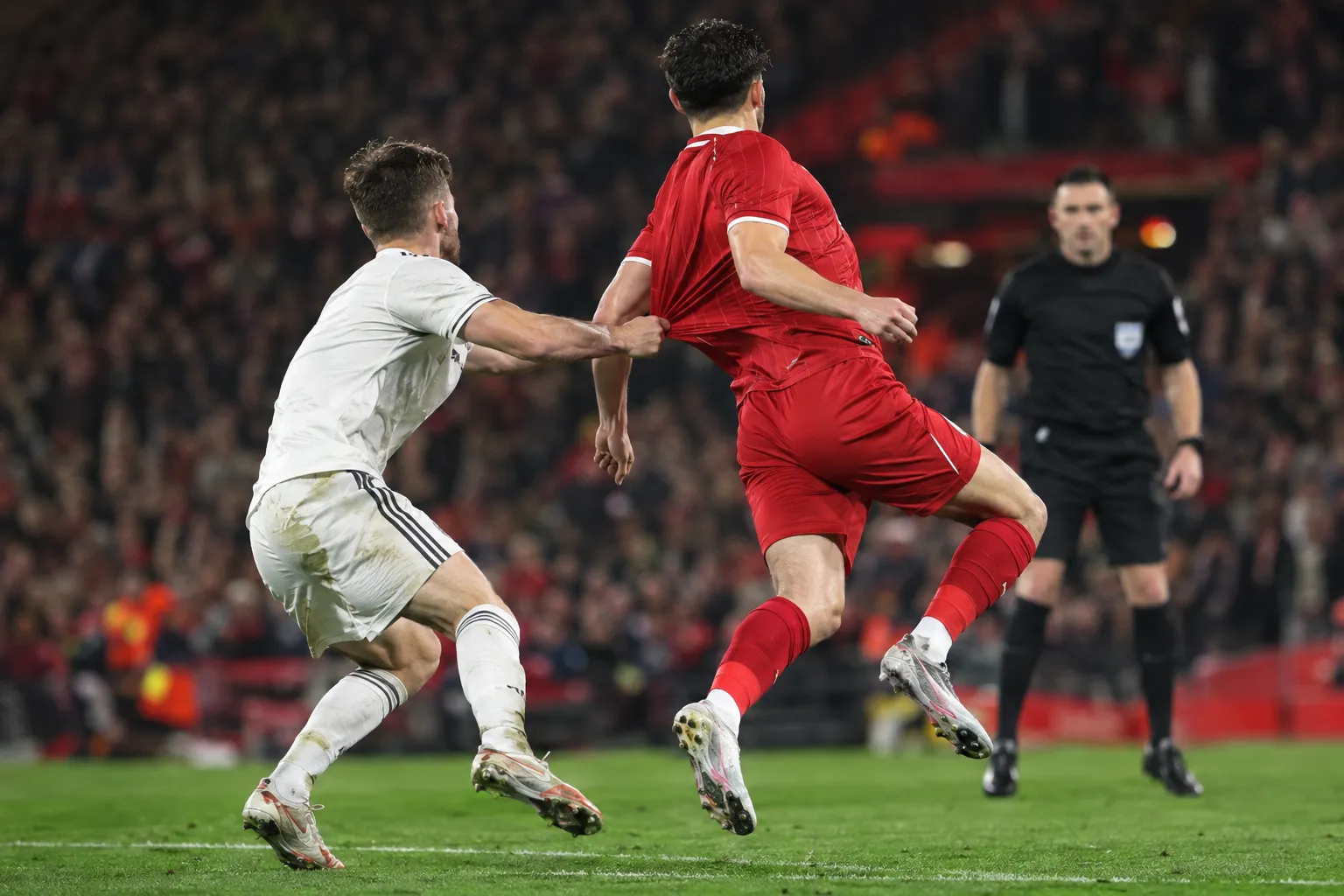
Standfirst — Beaten 1-0 by Arsenal at Anfield on Sunday 1 November 2026, Liverpool appealed for a penalty after Jurrien Timber pulled Alexander Isak’s shirt in the box. Referee Andy Madley did not give it, and video assistant Stuart Attwell did not recommend a review. The following day, Andoni Iraola strongly challenged that interpretation, going so far as to say he would advise his players to go down. Timber’s action is visible; whether it was a foul, and the threshold for VAR intervention, remain matters of judgement that should be considered separately.
An incident without a fall, followed by an unchanged decision
The incident came with Liverpool trailing after Kai Havertz’s goal in the 16th minute. As a cross came in, Isak tried to get into position to reach the ball and Timber held his shirt. The Swede stayed on his feet and did not immediately appeal for a penalty. Madley played on; Attwell did not recommend changing the decision. The match report published by Liverpool and the official match page confirm the result, the officials and the context of the incident.
The following day, Iraola revisited the incident and said Isak had been prevented from reaching the ball. According to reports by BBC Sport and Sky Sports, he believes a player who stays on his feet risks not getting the same decision as one who goes down. He said he would tell his players to go down in future. This was a frustrated reaction after a defeat, not an instruction whose implementation by Liverpool has been established.
What the law says — and what it does not decide on its own
Law 12 does not make every contact with a shirt automatically punishable. The IFAB defines holding as contact with an opponent’s body or equipment that impedes their movement. Its guidelines for match officials nevertheless call on them to take firm action against holding, particularly in the penalty area: if such an offence is committed while the ball is in play in the offender’s penalty area, it should result in a penalty.
The crux of the incident, then, is less whether there was contact than what effect it had: did the pull impede Isak enough as he tried to play the ball? The footage shows a grip on the shirt, but that does not make the referee’s interpretation indisputable. An attacker can be held without losing their balance; conversely, staying on their feet does not mean the action was lawful. The law concerns impeding an opponent, not the player’s ability to convince the referee by going down.
The video protocol sets another threshold. For a penalty or no-penalty decision, VAR intervenes only if there has been a clear and obvious error or a serious missed incident; the on-field decision does not change simply because a second interpretation is possible. That is the framework set out in the IFAB Laws of the Game 2026-2027. It explains why a contentious incident can be checked without leading to an on-screen review. On its own, it does not establish that the decision on Isak was right or wrong.
The real risk in Iraola’s message
Iraola’s remark stands out because it turns the usual debate about simulation on its head. Referees regularly face players exaggerating contact or going down without a foul; the laws provide for a caution for simulation when a player tries to deceive the referee. Here, however, the manager argues that an honest player who does not collapse despite having his shirt pulled may be less likely to get the decision.
The remark needs to be kept in context: it came the day after a defeat and bears the mark of a reaction in the heat of the moment. It does not prove that Madley or Attwell consciously waited for a fall. It nevertheless highlights a practical issue for refereeing: players and coaches may come to believe that showing the effect of contact matters as much as the contact itself. If that perception takes hold, it encourages theatrical gestures and makes it harder to distinguish a genuine foul from simulation.
A controversy that does not sum up the match
Liverpool’s club report confirms a 1-0 defeat, with Havertz scoring, and says Florian Wirtz hit the crossbar with a free-kick. The Reds also created other attacking opportunities, but public debate focused on Timber’s hold. The incident has therefore attracted considerable attention, without establishing that it alone explains the result: the home side did not score, and Arsenal held on to their lead.
Nuance also matters when analysing the footage. Replays make the pull visible, but assessing its duration, force and impact remains subjective. The available reports confirm the decision and Iraola’s comments; they do not constitute a detailed official explanation from the refereeing team of the precise reasons for not intervening. In the absence of such a published explanation, it would be excessive to state as fact that VAR refused to award the penalty because Isak did not go down.
What to watch for
In the short term, the incident brings a recurring question back into focus: does VAR make decisions on holding in the penalty area more consistent, or does it leave players facing an interpretative threshold that is too difficult to read? A useful answer would require comparing several similar incidents and knowing the criteria applied by referees, rather than drawing a general rule from a single match.
Ultimately, the strongest point is also the simplest: a hold should be judged by its effect on the opponent, not by their ability to go down. Iraola turns a contested decision into a criticism of the incentive players feel they face. Referees can take that warning on board without accepting his conclusion. Until an official analysis of this incident is made public, the debate should remain open — and a manager’s anger should not be mistaken for a confirmed refereeing interpretation.
Go to the source.
The references below document the research and let readers consult the original publications. Their number alone does not certify every statement in this article.
- bbcinsight.pages.devBBC Sport ↗Reference consulted · accessed on 02/11/2026
- downloads.theifab.comLois du jeu 2026-2027 de l’IFAB ↗Reference consulted · accessed on 02/11/2026
- liverpoolfc.comcompte rendu de la rencontre publié par Liverpool ↗Reference consulted · accessed on 02/11/2026
- liverpoolfc.comfiche officielle du match ↗Reference consulted · accessed on 02/11/2026
- Sky SportsSky Sports ↗Reference consulted · accessed on 02/11/2026
- theifab.comconsignes aux arbitres ↗Reference consulted · accessed on 02/11/2026