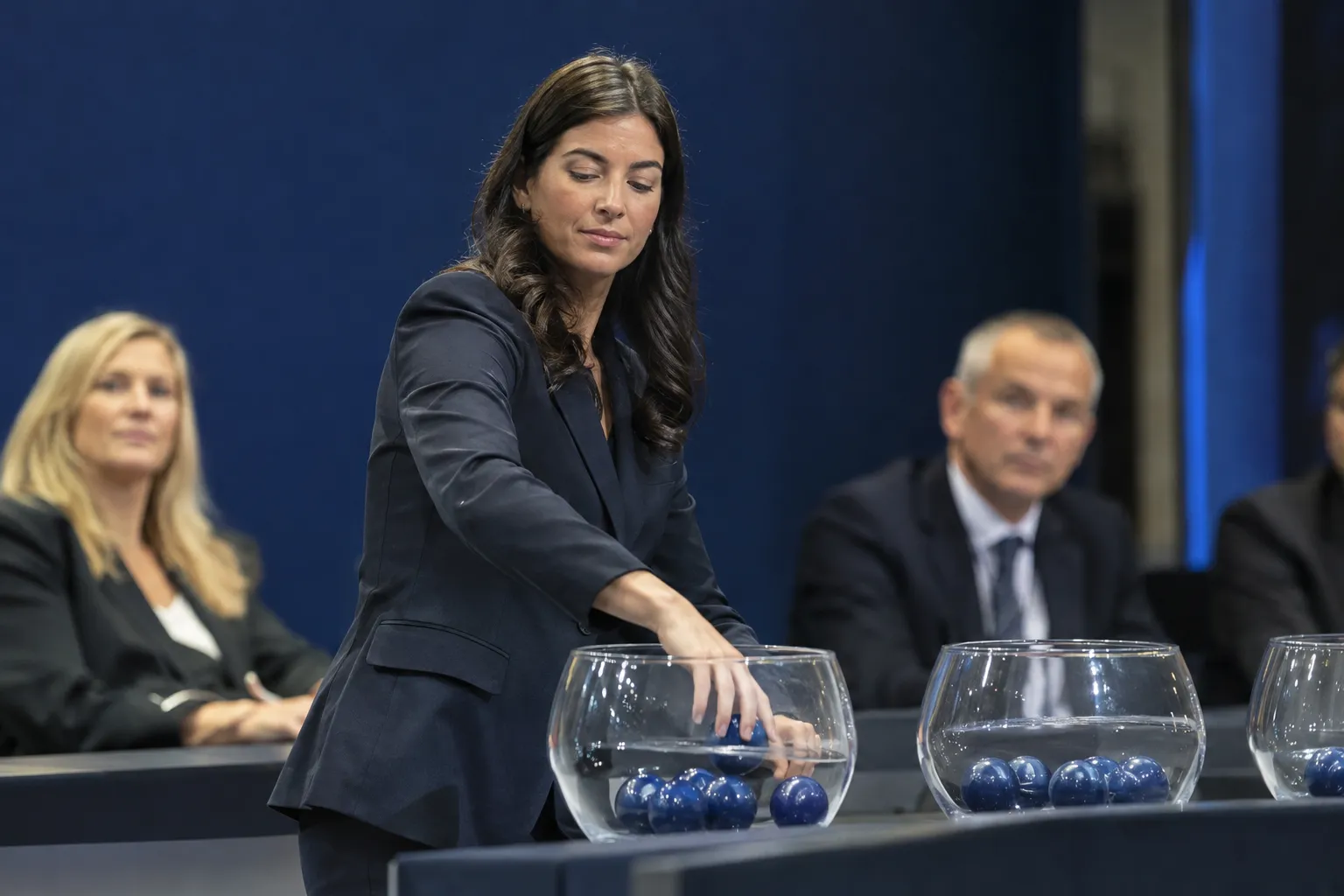
The draw for the 2027 Women’s Nations League, held in Nyon on Tuesday 3 November, has set the groups for a competition whose significance will extend well beyond the trophy. The four League A group winners will secure Europe’s places at the 2028 Olympic tournament; results will also determine qualification for the finals and movement between divisions. The new edition will feature 54 associations, a record that includes San Marino in its first participation in a senior UEFA women’s competition.
A draw that kicks off a season with two major stakes
The group line-up is now known following the ceremony held at UEFA headquarters. The governing body had confirmed the previous day that the 54 teams would be divided into three leagues: 16 in A, 16 in B and 22 in C. Leagues A and B each have four groups of four teams; League C has four groups of four and two groups of three. The format and schedule published by UEFA set out the framework for this edition, whose opening matchdays will begin in February 2027.
The draw is news from 3 November and should be distinguished from the preview articles published the previous day. The information available confirms the stakes, divisions and competition rules, but the official pages consulted at the time of writing do not yet provide a complete, corroborated list of the groups drawn. It would therefore be premature to name specific opponents for Les Bleues or the other teams here.
League A holds the key to the Olympic places
France will compete in the top tier alongside Germany, Spain, Denmark, England, Norway, the Netherlands, Italy, Ireland, Sweden, Iceland, Austria, Switzerland, Portugal, Scotland and Wales. These places stem from the final standings in the 2026 European qualifiers, rather than from a new draw to allocate the divisions. UEFA ranks Germany, Spain, Denmark and France among the group winners from the previous cycle; England, Norway, the Netherlands and Italy finished second. The final standings published by UEFA explain the starting hierarchy.
The biggest consequence is Olympic qualification: UEFA’s regulations stipulate that the four League A group winners will earn Europe’s places at the 2028 women’s Olympic tournament, subject to the eligibility criteria set by FIFA. The competition regulations also confirm that the four group winners will qualify for the semi-finals, which will be played over two legs. One group stage therefore opens two major doors: sporting success and Olympic qualification.
A format with consequences all the way down the divisions
The competition is not just about the battle between the leading nations. In League A, the teams finishing fourth will be relegated; the third-placed teams will contest play-offs against League B runners-up. The top four teams in League B will be promoted automatically, while the six League C group winners will move up a division. For less high-profile teams, promotion is a tangible objective, and the standings can affect the difficulty of the next qualifying cycle.
UEFA details the mechanism in its overview of the 2027 format. It creates stakes at several levels: reaching the finals at the top, holding on to a place in the middle, or moving up from League C. This system gives significance to matches that, in a crowded international calendar, might otherwise be seen as no more than fixtures to determine the standings.
San Marino, a new face in the competition
The 54th participant is also one of the distinctive features of this edition. San Marino’s senior women’s team is entering the Nations League after joining the competitive international scene. It will make its debut in League C; under UEFA’s rules, associations that did not take part in the previous cycle start at the bottom of that division.
San Marino’s entry expands the field, but should not be confused with any guarantee of immediate progress: the draw and results will determine the actual difficulty of its group. Before the ceremony, the San Marino Football Federation had explained that this campaign would mark the team’s first matches in which points were at stake. That prospect gives the tournament a development dimension, as well as its competitive pinnacle.
The schedule still has details to be confirmed
The league phase will be played across three windows: matchdays 1 and 2 between 23 February and 6 March 2027, matchdays 3 and 4 from 13 to 24 April, and the final two matchdays from 7 to 15 June. The finals and promotion-relegation play-offs are scheduled for the autumn. These dates provide the continental framework, but are not enough to establish the days, kick-off times and venues for each match: the national associations and UEFA still need to announce the detailed schedules.
For Les Bleues, the immediate priority is therefore to find out their opponents and assess the group’s level of difficulty, rather than already drawing conclusions about Olympic qualification or a run at the title. The draw deals the cards; it does not determine the teams’ form or their ability to handle successive international windows. The next step will be the publication of the full schedules, after which the action on the pitch will decide.
The 2027 Nations League thus opens a cycle in which every result can have an impact over several seasons: the finals, qualification for the Games and positioning for the 2029 European Championship qualifiers. The draw on 3 November sets the fixtures; the hierarchy remains to be built.
Go to the source.
The references below document the research and let readers consult the original publications. Their number alone does not certify every statement in this article.
- documents.uefa.comrèglement de la compétition ↗Reference consulted · accessed on 03/11/2026
- editorial.uefa.comclassement final publié par l’UEFA ↗Reference consulted · accessed on 03/11/2026
- UEFAformat 2027 ↗Reference consulted · accessed on 03/11/2026