
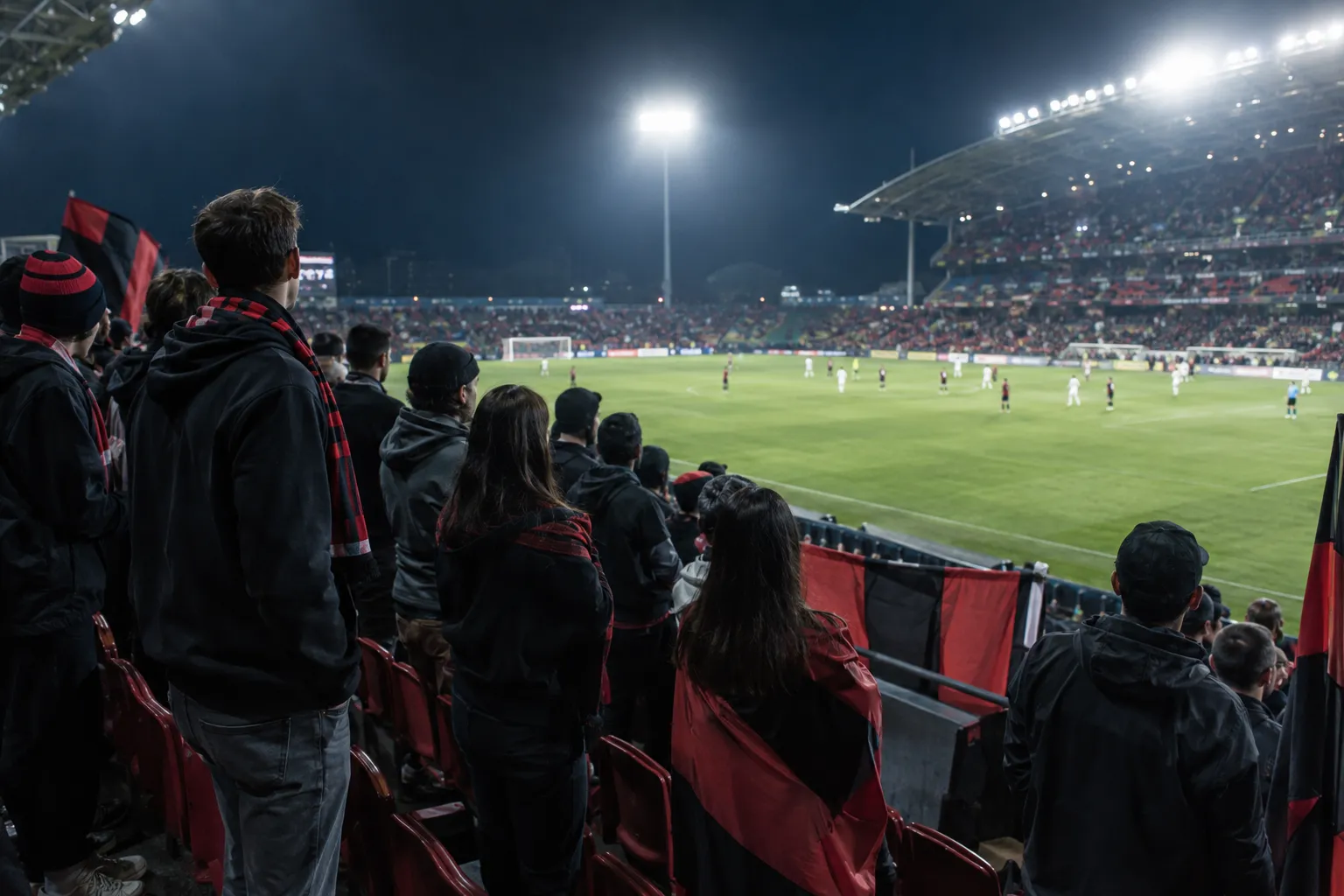
The latest development, confirmed on Monday 2 November 2026, is a public statement from Paul Lederer, chairman of Western Sydney Wanderers, who called the treatment of the club’s supporters “unacceptable” and said he wanted answers from the authorities. His statement followed a 20-minute silent protest by the Red and Black Bloc (RBB) during Saturday’s match against Macarthur in Campbelltown. The dispute concerns the policing of supporters, but the detailed account of police instructions and their justification remains incomplete. The club published Lederer’s letter ; the Australian ABC also reported the circumstances and sought comment from the parties involved.
A protest made visible by its absence
On Saturday, the RBB remained silent for the first 20 minutes of the league match between the Wanderers and Macarthur at Campbelltown Sports Stadium. Both supporters’ groups had announced the action before the game; Macarthur’s active support group, the Bullpen, was due to join the gesture of solidarity. The match ended in a goalless draw, according to the host club’s report, but the protest was about the stands, not the pitch. Advance coverage of the protest had already highlighted the dispute over instruments and banners.
The ABC reports that the RBB says New South Wales Police asked them to hand over drums, a megaphone and banners about two hours before kick-off. This account is attributed to the group: on its own, it does not independently confirm the content of the instructions or the grounds for them. Banners seen in the stadium included a message calling for supporters to be defended rather than police demands, according to the Australian public broadcaster.
The chairman puts the club at the forefront
In his letter dated 2 November, Lederer describes recurring difficulties since the start of the season. He also cites hundreds of supporters being made to wait at the entrance to the Sydney derby and, at times, up to 20 officers from a public order unit being positioned behind the fans’ section at Campbelltown. These figures and incidents are those cited by the club chairman and reported by the ABC; we have not found a public account from the authorities that would allow them to be independently verified.
The distinction matters: Lederer explicitly acknowledges the responsibility of the police, stadium operators and A-Leagues for safety, while arguing that their actions must remain fair and proportionate. He also says the club does not defend antisocial behaviour and that those responsible must be held accountable. In his argument, then, the dispute is about how an entire group of supporters is treated, not about the absence of rules or individual responsibility.
Support that extends beyond the club’s leadership
The ABC says the coaches of both teams, Ufuk Talay for the Wanderers and Sasa Ognenovski for Macarthur, expressed their support for the fans after the match. This show of support gives the protest a significance that goes beyond a dispute between a group of fans and the authorities: it also puts clubs and other figures in the game in front of the question of the atmosphere they want to preserve in their competition.
The RBB is a recognised part of the Wanderers’ identity, and Lederer emphasises the role of chants, drums and colours in the life of the club. This is as much an institutional position as a gesture of solidarity. It is a reminder that active supporters contribute to the stadium experience, but it does not resolve the operational debate: a security operation may respond to specific risks, while a response seen as excessive can discourage participation and damage relations with clubs. The information published on Monday is not enough on its own to assess whether the response was proportionate.
A tense backdrop, but not evidence in this case
The statement comes after other tensions between supporters, police and security at Australian football matches. In an earlier article, the AAP news agency reported incidents in Brisbane and at the Sydney derby, as well as a response from A-Leagues saying it was reviewing some incidents with clubs, stadiums and police. The AAP report provides useful context, but does not verify the events at the Campbelltown match.
These separate incidents should not be turned into evidence of a uniform policy or of a proven link with changes in attendances. The information available on Monday mainly documents the protest, the Wanderers’ statement and the supporters’ account as reported by the media. It does not include a detailed response from New South Wales Police about the instructions given before the match, or a full explanation from A-Leagues of its role in this specific case.
The next step: verifiable answers
Lederer says the club will continue to raise its concerns with the police, A-Leagues and other relevant parties. That is the concrete next step to watch: whether the authorities confirm the measures described, what rules they were based on, and whether formal discussions lead to clearer criteria for drums, banners and other elements of matchday atmosphere.
For the Wanderers, the challenge is to defend their supporters without downplaying safety; for those responsible for policing, it is to explain their decisions without automatically equating collective passion with risk. The silent protest made this tension impossible to ignore. But until the other parties have set out their accounts and the evidence supporting them, the debate remains open — and the club’s central request for a detailed response remains unanswered publicly.
Go to the source.
The references below document the research and let readers consult the original publications. Their number alone does not certify every statement in this article.
- aapnews.aap.com.auCe compte rendu de l’AAP ↗Reference consulted · accessed on 02/11/2026
- abc.net.auABC australienne ↗Reference consulted · accessed on 02/11/2026
- proteazone.comLa couverture préalable de la contestation ↗Reference consulted · accessed on 02/11/2026
- wswanderersfc.com.auLe club a publié la lettre de Lederer ↗Reference consulted · accessed on 02/11/2026