
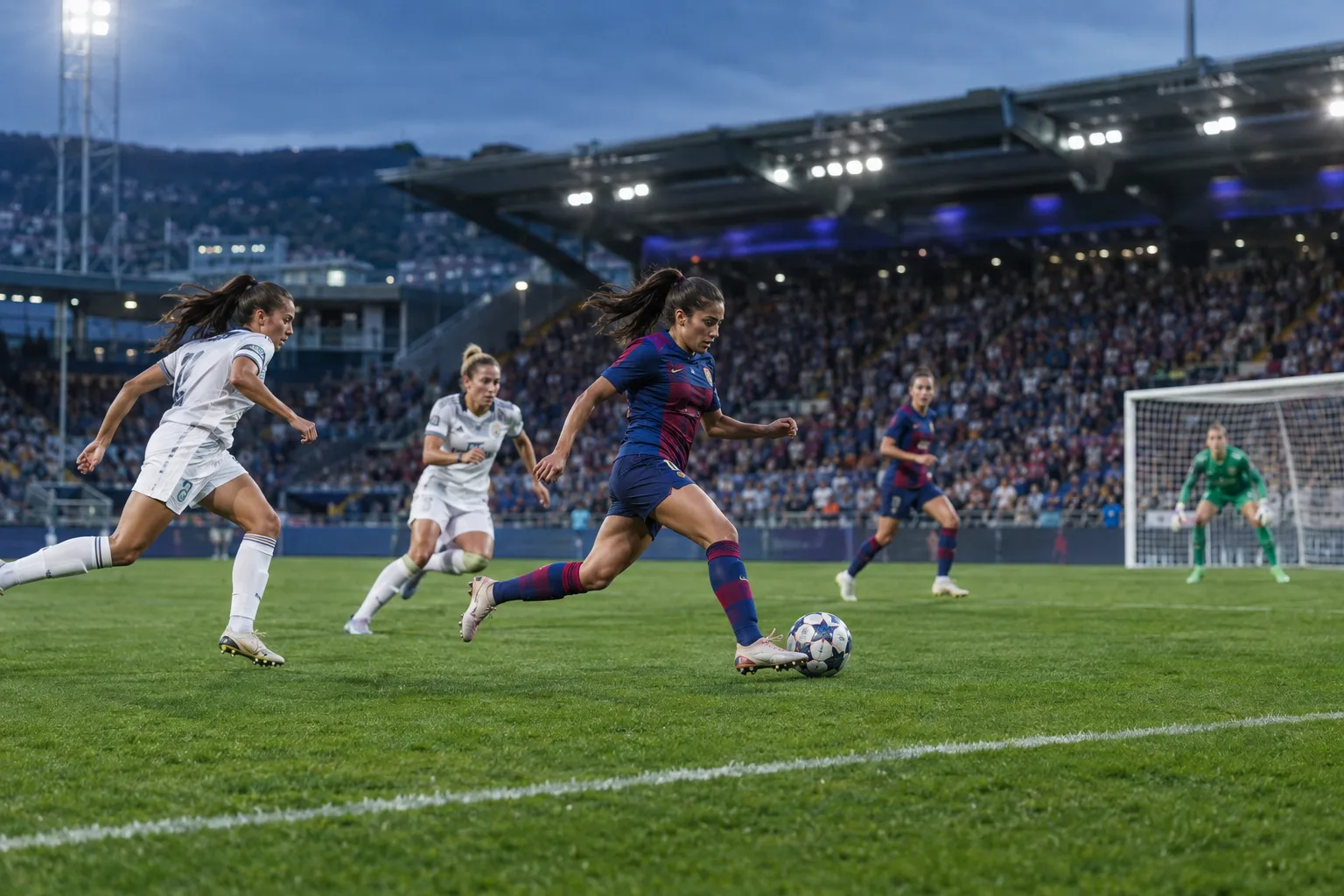
In Oslo on 23 May 2026, Barcelona beat OL Lyonnes 4-0 in the Women’s Champions League final. The score suggests complete domination; the match was more competitive than that. Lyon disrupted Barcelona’s build-up and created chances, but failed to make the most of their spells on top. Barcelona, meanwhile, held firm, adjusted their build-up and punished the spaces that opened up after the break. A combined reading of UEFA’s technical report, Coaches’ Voice’s analysis and reports by The Guardian and Le Monde leads to an essential qualification: Barcelona’s efficiency made the difference, but it was built on a genuine tactical contest, not a one-sided final.
Lyon cut off the first pass and isolated Patri Guijarro
Jonatan Giráldez knew Barcelona’s game well: he had coached the Catalan club before taking charge of OL Lyonnes. His plan initially targeted the starting point of their passing. According to the detailed analysis by Coaches’ Voice, Melchie Dumornay tracked Patri Guijarro, while Lindsey Heaps closed off the inside passing lanes to Alexia Putellas and Clara Serrajordi. Ada Hegerberg directed the first line of pressure; Selma Bacha and Ashley Lawrence pushed up to reduce the space and force one-on-one duels.
The set-up worked: Barcelona struggled to impose their usual patterns and had to play more vertically. UEFA noted that Barça finished the first half with less than half of the possession, an unusual situation in their European campaign, and had not scored before the break. The technical report on the final describes a coordinated man-to-man press capable of forcing high turnovers.
But that aggression came at a price: to close off the passing lanes, Lyon’s players had to push up together and maintain the right distances. If one player jumped too early or too late, a pass could bypass the first line of pressure. Giráldez’s plan contained Barcelona without eliminating the threat of runs in behind the defence, which had already been visible before half-time.
Barcelona’s response: move the reference points, don’t force the issue
Barcelona did not solve the problem by accelerating constantly or making a radical change of system. Coaches’ Voice’s report describes a gradual adjustment: Guijarro stopped remaining fixed in front of the defence, moving to draw out or confuse her opponents’ reference points; Alexia Putellas and Serrajordi moved closer together and offered diagonal passing options. These movements recreated links in the inside channels without abandoning a rational use of space.
UEFA observed the same mechanism from a different angle: Barcelona sought to draw an opponent in before accelerating, and Alexia could receive between the lines before releasing Ewa Pajor’s run in behind. That moment of waiting matters. Beating the press does not necessarily mean playing forwards immediately; first, the block must be moved, then the moment when space appears must be chosen. Lyon’s defence continued to push up, but its attempts to step out became harder to synchronise.
The opening goal, in the 55th minute, offers a concrete example of this shift. Patri Guijarro carries the ball forward and plays in Pajor, who uses her first touch to get the better of Ingrid Engen before finishing. UEFA highlights the coordination between Guijarro’s carry, the forward’s change of pace and her first touch into space. The Guardian’s report also emphasises the importance of this first breakthrough, which came after Lyon had controlled the match better up to that point.
Transitions: a win that does not fit the Barça stereotype
Perhaps the most telling tactical thread is the least expected: the team associated with control of the ball made the difference in transition. According to UEFA, all four of Barcelona’s second-half goals came from transition situations or phases in which the game had opened up, rather than long spells of possession against a settled defence. Winning the ball back was not enough; the first pass had to be played forwards, the player on the ball had to choose quickly and the run had to be timed right.
Pajor gave the Catalan attack a constant threat in behind. Her runs forced the defenders to watch the space behind them and limited their freedom to push up without caution. She scored the opener, then the second in the 69th minute, after a team move finished close to goal. In the 90th minute, Salma Paralluelo found the top corner; in stoppage time, she scored again at the end of a counter-attack. The details of the final published by UEFA also confirm that Lyon had to take greater risks after falling behind.
This gradual opening-up of the game partly explains the final margin. When OL sought to get back into the match, the spaces widened; Barcelona then had more room for their quick attackers. Le Monde notes that 0-4 was harsh on the balance of the first hour, while judging the result logical given the missed chances and Barcelona’s ability to punish mistakes. The final score therefore tells the story both of the quality of Barcelona’s attacks and of how the match changed when Lyon had to push forward.
Cata Coll, a prerequisite for victory
Reducing the final to the finishing of Pajor and Paralluelo would overlook the Catalan goalkeeper’s contribution. Before the opener, Cata Coll pushes away a header from Wendie Renard, then deals with several more Lyon attempts. After the 1-0, she saves a shot from Vicki Becho in particular; at 2-0, she wins her one-on-one against Tabitha Chawinga. UEFA highlights her interventions in different situations — at 0-0, 1-0 and 2-0 — and stresses her composure as well as her technique.
The timing matters: these saves prevent Lyon from turning their spells of pressure into an equaliser and keep Barcelona in a match where a single goal for the opposition could have changed both teams’ decisions. The Guardian and UEFA’s report also report that Renard’s header, followed by Lindsey Heaps’ goal, was ruled out for offside. The episode is a reminder that a significant chance does not necessarily count as a goal; however, it is not enough on its own to explain the result.
What this final tells us — and what it does not prove
The final offers a textbook example of the limits of an ambitious press: it can stop a team playing to its usual patterns, but it leaves the defensive block exposed when the first lines are bypassed or poorly coordinated. It also shows that a possession-based team can win without dominating the ball throughout, if it can withstand a spell under pressure and then turn regains into direct attacks. These observations are in line with the analysis of UEFA’s technical observers, but remain specific to one match, the players available and the way it unfolded.
They prove neither that Lyon’s pressing was inherently a mistake nor that Barcelona should now abandon possession. OL created chances and controlled part of the first half; Barcelona needed Coll and exceptional execution to come through that spell. Similarly, the 4-0 scoreline alone does not measure the true gap between the two teams: Le Monde notes that they had won ten of the previous eleven editions of the competition, a sign of a top-level rivalry rather than an unbalanced contest.
The useful lesson is more precise: against a man-oriented press, playing out depends on more than the technical quality of the first pass. It requires movement that can shift opponents’ reference points, a credible threat in behind and a goalkeeper ready to preserve the balance when the plan is not enough. In Oslo, Barcelona combined all three responses — then showed rare efficiency in the decisive areas. It is this combination, more than the raw scoreline, that explains how OL Lyonnes were beaten.
Go to the source.
The references below document the research and let readers consult the original publications. Their number alone does not certify every statement in this article.
- es.coachesvoice.comCoaches’ Voice ↗Reference consulted · accessed on 03/11/2026
- es.uefa.comcompte rendu de l’UEFA ↗Reference consulted · accessed on 03/11/2026
- The Guardianrécit du *Guardian* ↗Reference consulted · accessed on 03/11/2026
- UEFAcompte rendu technique de la finale ↗Reference consulted · accessed on 03/11/2026
- UEFAdétails de la finale publiés par l’UEFA ↗Reference consulted · accessed on 03/11/2026